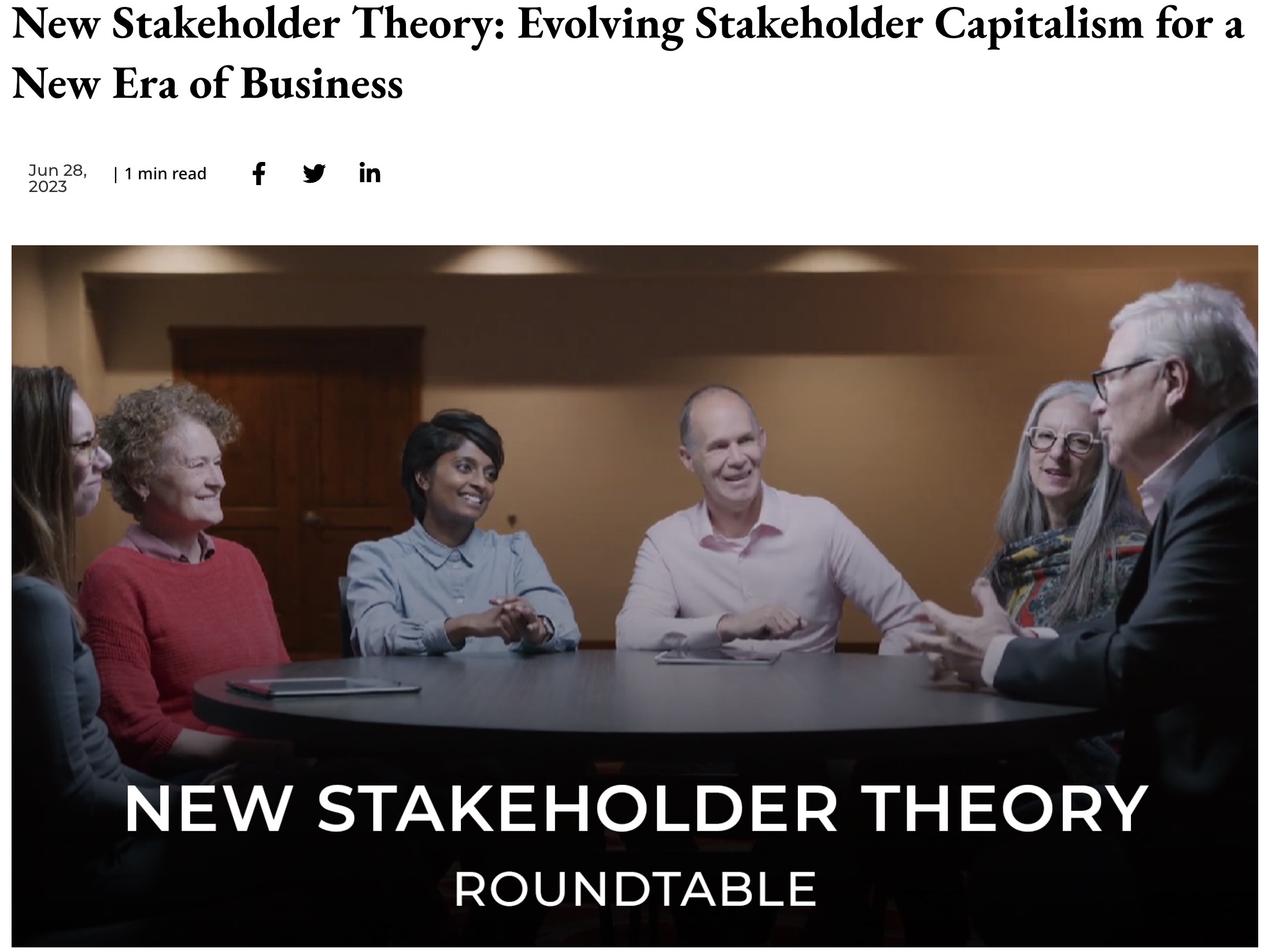
Re-Imagining Traditional Stakeholder Theory: A Roundtable Discussion
Sarah Kaplan participated in a Sorenson Impact roundtable on corporate purpose and being a business in the 21st century.
At the 2023 Stakeholder Conference, hosted by a distinguished group of global scholars, including Jay Barney, Presidential Professor of Strategic Management and the Pierre Lassonde Chair of Social Entrepreneurship at the University of Utah, Sorenson Impact Center was honored to join an impressive group of business and academic leaders to explore new alternatives to traditional stakeholder thinking.
Sorenson Impact Center CEO Geoff Davis led a roundtable discussion at the event with a group of leading impact professionals to explore the theory of stakeholder capitalism and how it is evolving for a new era of business. Read highlights from the conversation, or watch the full discussion below.
- Jay Barney, Ph.D., Presidential Professor of Strategic Management and the Pierre Lassonde Chair of Social Entrepreneurship, University of Utah David Eccles School of Business
- Allison Boxer, Ph.D., Managing Director of Academic Programs, Sorensen Impact Center at the University of Utah David Eccles School of Business
- Sarah Kaplan, Ph.D., Professor, University of Toronto Rotman School of Management; Director, Institute for Gender and the Economy
- Anita McGahan, Ph.D., Professor, University of Toronto Rotman School of Management; affiliated with the Burnes Center for Social Change at Northeastern University
- Pushpika Vishwanathan, Ph.D., Assistant Professor, University of Amsterdam
In the course of a lively discussion, the panelists talked through several key issues impacting the next generation of stakeholder capitalism and how they see it playing out in practice.
On dealing with conflicting stakeholder interests:
The original notion of stakeholder capitalism often touted the idea of “win-win”: That we could do good while making money, no sacrifices. This new version of stakeholder capitalism acknowledges that all issues won’t be “win-win” — in order to prioritize one value, sometimes another value must be de-prioritized. Today’s companies and leaders must figure out how to identify which values to prioritize; be willing to make tough strategic decisions to uphold them; and to articulate these values to unify all stakeholders around those decisions.
Kaplan: Companies often don’t know how to deal with the fact that there are multiple stakeholders who have different interests — and a single stakeholder may have multiple kinds of interests. Even shareholders aren’t totally profit-driven and returns-oriented; they often invest with their values. As an organization, how do you deal with those trade-offs?
More here.